
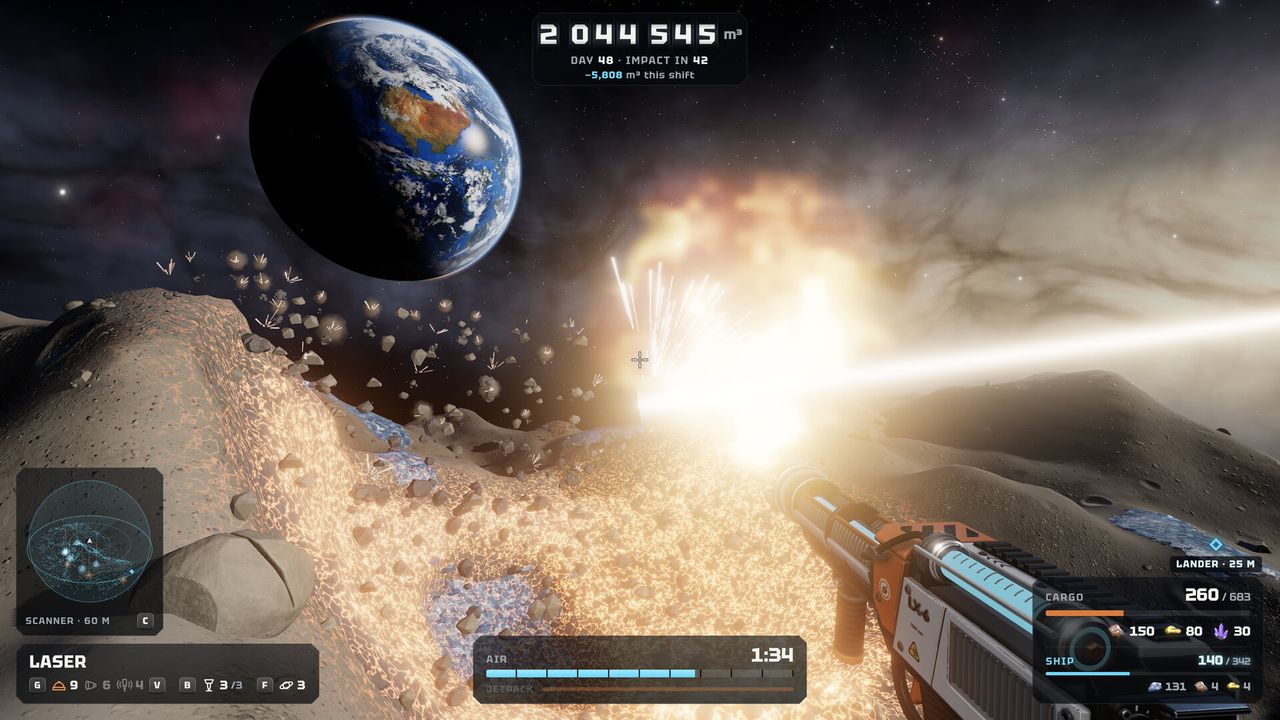
What the 90-Day Counter Actually Measures
The counter is not a turn limit. It is the volume of asteroid still on a collision course, expressed as time. Every cubic metre you remove reduces the impact mass; the day count is the deadline for removing enough of it.
That distinction changes how you read the HUD. A day where you dug a lot but sold badly can leave the counter almost unchanged, because the ore you failed to bank never became upgrades. Efficiency, not effort, moves the number.
The game states the target plainly: 5,000,000 m³. Early on the counter barely moves, which is intended. The design expects your first days to be slow and your later days to be carried by tools and ship guns.
How a Day Is Spent
A day is a round trip. You descend, you dig until air or cargo stops you, you return, you sell, you spend. In the footage we reviewed the player summarizes it as 'every trip is a day' — which is the most useful planning sentence in the game.
Because a trip is a day, a failed trip is not a small error. Blacking out on the way back costs the cargo and the day. That is why experienced players leave a margin on the air bar rather than mining until it flashes.
The practical rule for the first week: end each shift with roughly a fifth of your air remaining. You will bank less per trip and finish more trips, which compounds.
The First Ten Days
Days one to three are about air and cargo. If you cannot stay down long enough to fill a hold, nothing else matters. Air tanks roughly doubled the usable shift in the footage we reviewed, and that upgrade is the single biggest early quality-of-life change.
Days four to seven are about digging speed and the tether. Faster digging without a reliable way home just moves the failure point deeper. Buy the tether, then put money into hit power and tempo.
Days eight to ten are the first real decision: keep upgrading the pickaxe, or step up to the sledgehammer at $500. If your air and cargo are already comfortable, the sledgehammer pays for itself quickly. If they are not, it will not.
Mid-Run: When Ship Guns Take Over
Your ship starts unarmed. Guns are bought with ore money and fire at the asteroid automatically, which means the counter keeps falling while you dig. That is the moment the game changes from a mining game into a production line.
The most expensive ship weapon fires a black hole into the rock. You do not need it in the first week, but you do need to know it exists, because it reframes spending: every credit spent on a personal tool is a credit not spent on the thing that works while you sleep.
A reasonable mid-run split is tools first until a shift feels comfortable, then ship guns until the counter visibly drops between trips, then back to tools.
What Happens If You Fall Behind
The game does not punish you with a hard fail state in the opening hours; it punishes you with a counter that moves too slowly. Falling behind looks like long shifts, small hauls, and a hold that fills with cheap rock.
The fix is almost always economic rather than mechanical: sell more often, refine before selling once the option is available, and stop hauling anything that does not justify the walk.
Co-op is the other lever. Eight miners on one asteroid remove volume far faster than one, provided the shared wallet is spent on things that help everyone rather than one player's new toy.